Why Home Assistant?
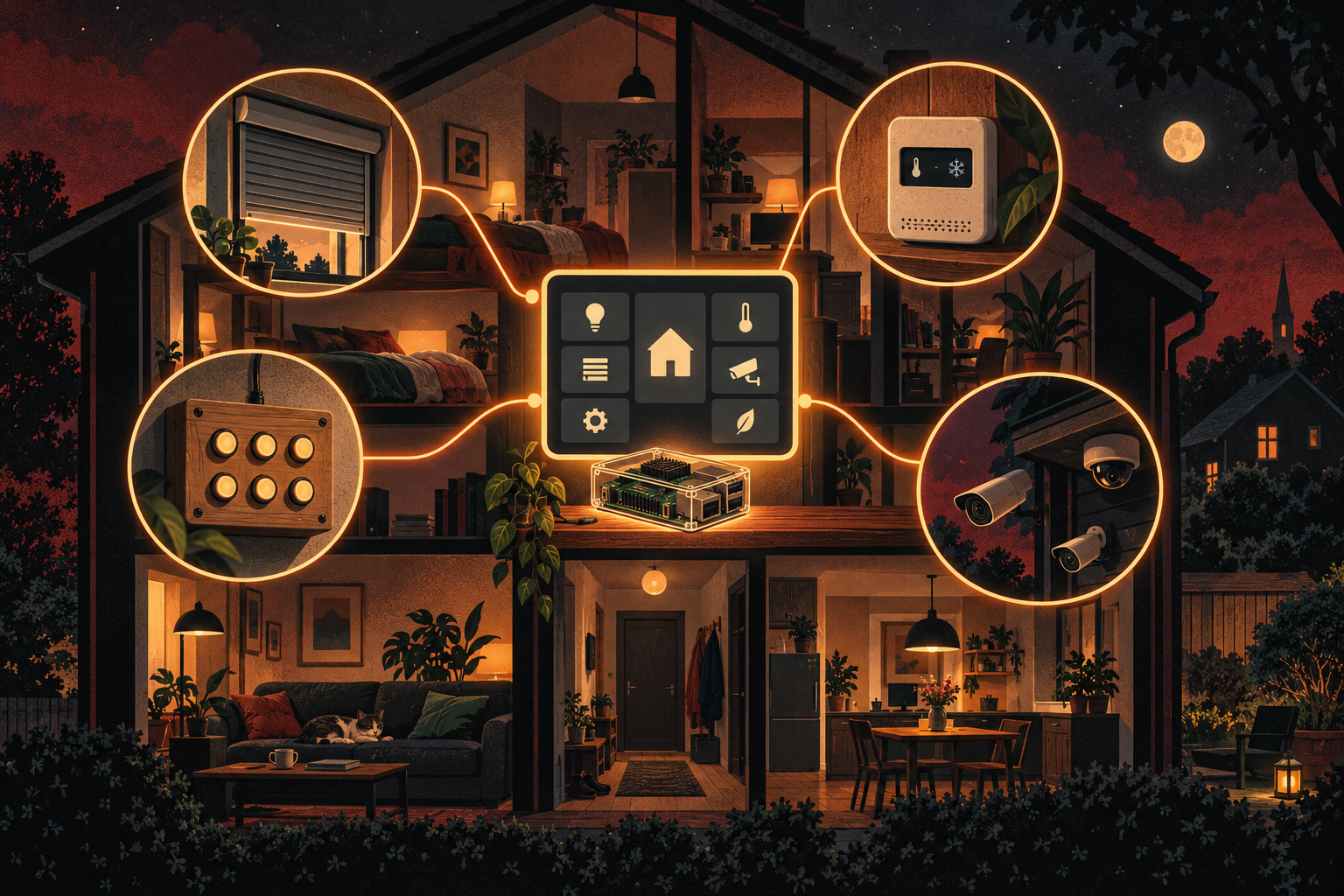
I do not want to depend on a separate app or cloud service for every device. Home Assistant lets me bring devices from different sources together in one environment. More importantly, I can add solutions that I design and program myself.
For me, Home Assistant is therefore more than a dashboard. It is the connecting layer between electronics, sensors, controls and everyday life at home.
The foundation
Home Assistant runs on a Raspberry Pi as a separate system that remains continuously available on my home network. ESPHome simplifies the connection with my self-built microcontroller projects. Devices can expose their sensors, switches and settings directly to Home Assistant.
I can then combine these devices in dashboards and automations, even when they were not originally designed as one system.
I built a controller for a blind using an ESP32, a stepper motor and ESPHome. Home Assistant can operate the blind and set a desired position.
During development, it became clear that mechanical movement and software state must stay aligned. After a power interruption, the software does not automatically know the blind’s physical position. A way to correct that position is therefore part of a reliable solution.
SwitchBox6 is a self-built wireless control box with six physical switches. It is intended to operate Home Assistant functions directly without opening a phone, touchscreen or dashboard every time.
Because the box must also be able to run on a battery, this project is about more than controls. Power consumption, measurement frequency and only responding when a switch actually changes are equally important parts of the design.
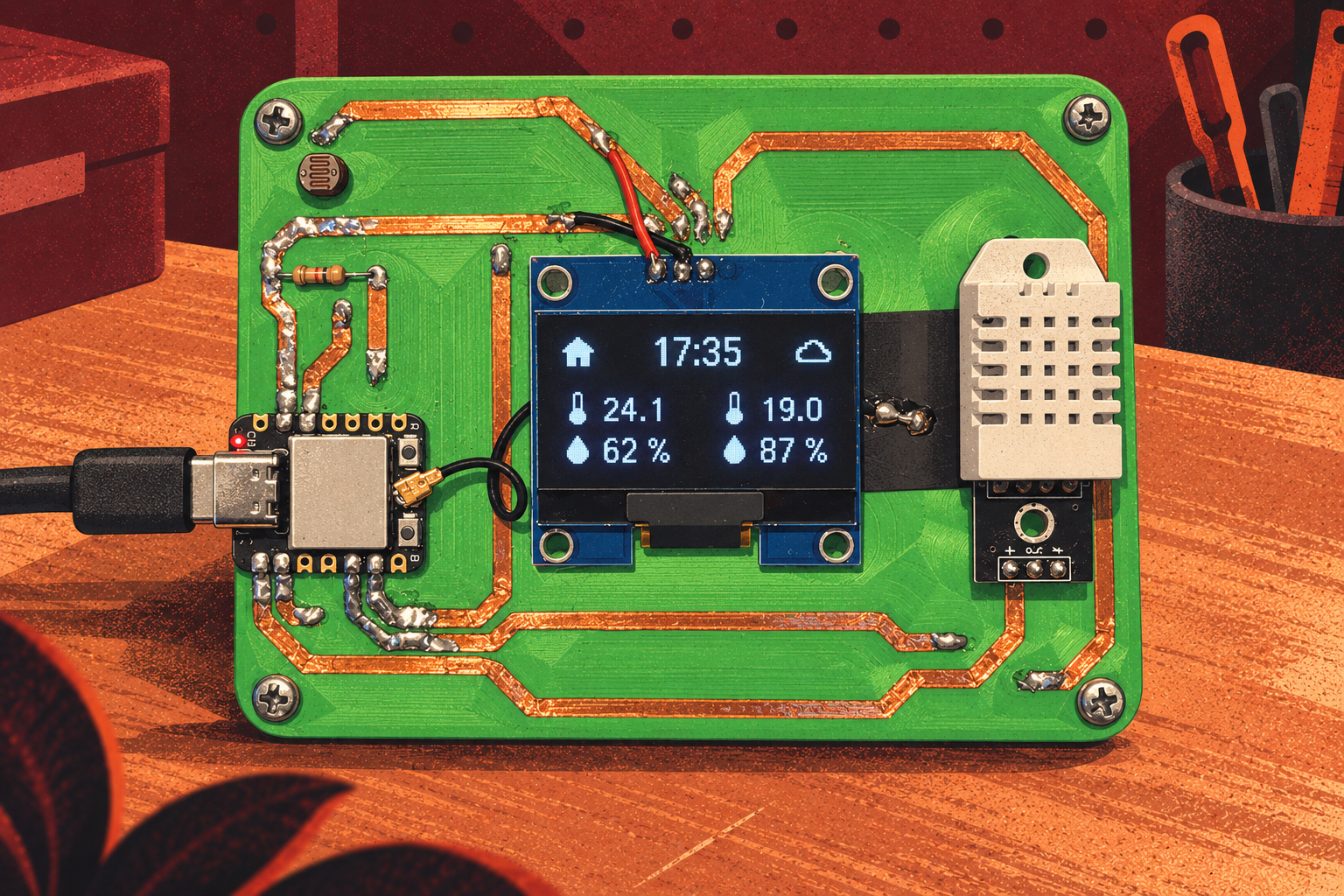
A compact ESP32-C3 combines a temperature sensor with a small OLED display. Measurements appear locally and are sent to Home Assistant through ESPHome at the same time.
This simple node shows how local feedback and central recording can complement one another. Calibration matters too: a sensor value is only useful when its reliability is known.
Experimental touchscreen
I am also experimenting with a touchscreen based on an ESP32-S3. It can show information from Home Assistant, such as weather data, network status and controls for local outputs.
This brings electronics, graphical controls and home automation together. It is still an experimental setup, but it helps me explore when a fixed control screen is more useful than a phone.
Frigate as the next connection
My Frigate setup for local camera detection will be an important next connection. The aim is to make events and camera images useful within Home Assistant without giving up local processing.
This integration is still in development and is therefore not presented as complete.
What already works
- Home Assistant runs as the central home automation system on a Raspberry Pi.
- Self-built ESPHome devices can connect directly.
- The blind can be operated and moved to a set position.
- SwitchBox6 provides physical controls for Home Assistant functions.
- A sensor and display node combines local information with central recording.
- New experiments can be added to the same environment step by step.